Showing posts with label MORE MOVIE REVIEWS. Show all posts

My Friend Pinto (Movie Review)

Posted by pawon on Wednesday, October 19, 2011

"Zindagi khwab hai khwab mein sach hai kya aur bhala jhooth hai kya?" Remember Motilal's staggering existentialism in 1956's "Jagte Raho"? Some such philosophy underlines the key goings-on in "My Friend Pinto" -- a wispy, nostalgic comedy about a Goan simpleton's one night of zany adventures in the mad mad bustle of Mumbai during New Year's eve.

This isn't the first film that explores Mumbai by night. From Khwaja Ahmed Abbas's "Bambai Raat Ki Bahon Mein" to Sudhir Mishra's "Iss Raat Ki Subah Nahin", the dark comic side of the city's underbelly has ceaselessly fascinated Bollywood since long before the term 'Bollywood' was invented.

Debutant director Raghav Dar switches on the innovative mode full-blast. The first and most conspicuous component in his comic romp is the director's sense of fun.

He is fearless about the fun quotient that he has while going with one sumptuous swoop into lives as different from one another as any two homes, families that live in Mumbai can be.

A semi-retired gangster (Makarand Deshpande) and his never-been star-actress mistress (Divya Dutta), his twin assassin-goons Ajay and Vijay (played by real life Amin and Karim Hajee who were last seen together on screen dancing in a Sufi trance to A.R. Rahman's devotional number in Jodhaa-Akbar), an old taxidriver and his gambler-son (theatre actor Shakeel Khan making a stellar screen appearance), a lost girl Maggie(Kalki Koechlin) abandoned by her small-time crook boyfriend on the railway station, the competitive couple (Arjun Mathur and Shruti Seth) coping with the sudden appearance of an unwanted guest from Goa, even as they try to cope with the fissures in their own marriage... These, then, are some of the characters who show up one night in Dar's 'Mumbai raat ki bahon mein' (Mumbai at night).

There are many others. Oh yes, characters pop out of every nook and cranny like rabbits from a hat. Bringing them all together is the Goan Mama's boy, the simpleton Michael Pinto who we're informed, with tongue firmly in the scriprwriter's cheek, is the nephew of Albert 'jissko bahut gussa aata tha' (who gets very angry).

The reference to Saeed Mirza's 1980 cult classic "Albert Pinto Ko Gussa Kyon Aata Hai" is not lost in the film's melee of bustling adventures. The film is knowledgeably laden with references to cinema and cinematic devices from the past including a very pointed allusion to a corpse's journey across Mumbai from Kundan Shah's "Jaane Bhi Do Yaaron".

"My Friend Pinto" is a very complex script to write and an even more complex act to pull off on screen. Dar manages the chaos created by Michael Pinto's misadventures across the celebratory streets of Mumbai with fluency and grace.

The awkwardness that we encounter in the storytelling is purely by design. Pinto is put into all kinds of bizarre and embarrassing situations. Like Charlie Chaplin in the silent films, he walks out of the chaos unscathed.

He is a Goan angel in disguise. He's Chaplin, Raj Kapoor and Guru Dutt from "City Lights", "Jagte Raho" and "Pyasa". He is all of those and none of them.

Prateik with his waif-like quality truly finds himself as an actor when he plays a lost character. "My Friend Pinto" needed his vulnerability and uncertainties.

The supporting cast is impressive, with Divya Dutta and Makrand Deshpande having a ball with their guns and games. They are like two bulls in a sex shop. Arjun Mathur as Pinto's desensitised Mumbai friend creates quite a graph for his character within the limited space provided by the restless script.

Quirky, capricious, whimsical and at times magical (watch those Broadway-styled musical performances), "My Friend Pinto" conveys the key comic patterns of Kundan Shah's "Jaane Bhi Do Yaaron".

Prateik echoes the innocent adventures of Raj Kapoor in "Jagte Raho". Dar's directorial debut is endearing in its eccentricity.

When you leave the crazy comic cosmos of Pinto's world behind, you take away with you a film that is fiercely original in concept and designed to deliver tongue-in-cheek swipes at all those scared cows of Bollywood that we grew up watching and loving without knowing why we loved them in the first place.

There is something about "My Friend Pinto". But you don't really know what.
More about → My Friend Pinto (Movie Review)

Mujhse Fraaandship Karoge (Movie Review)

Posted by pawon on Tuesday, October 18, 2011

"Mujhse Fraaandship Karoge" is a sweet teen romance in the times of broadband connection, social networking sites and fake IDs! It explores the pros and cons of the proposed 'fraaandship' networking in our lives. It offers food for thought with - "SACH is the key word and face to face connection is the best connection."

A new era love story, the film revolves around four characters - Vishal Bhatt (Saqib Saleem), Rahul Sareen (Nishant Dahiya), Preity Sen (Saba Azad) and Malvika Kelkar (Tara Dsouza).

Set in a college campus, Vishal with pal Hacky (Prabal Panjabi) are up to pranks with fellow classmates. These initial scenes are a direct rip-off from the Hollywood film "The Social Network".

After a few complicated moments one realises that prankster Vishal is a good writer who pens lyrics for rockstar pal Rahul. Girls are crazy about Rahul, but Rahul seems indifferent towards them.

Also on campus is an odd, boorish and unladylike Preity Sen who is good at photography. She happens to be friends with the hot and happening Malvika Kelkar.

It so happens that Malvika's id pops up on Rahul's profile page and since he is disinterested in adding friends on his Facebook, Vishal takes the initiative. But unknown to him Malvika's id is being operated by friend Preity. And that's where the complication in the love story begins.

Vishal chats with Preity thinking it is Malvika. And Preity chats with Vishal thinking it is Rahul. They are head over heels in love in their virtual world.

Meanwhile, the college is celebrating its silver jubilee. The theme for the evening is - A photographic documentary of the romantic history of the college. Vishal and Preity are forcibly thrown together for the project. The inevitable happens. They are attracted to each other, but they still fantasise about their virtual relationship.

But how long can fake identities sustain the real love? Reality bites when they confront each other.

Nupur Asthana has deftly handled this complicated love story. In the beginning one does get a bit disoriented trying to establish the complicated relationship. But after the initial hi-cups, the story sets in. The first half is nothing to write home about and the second half gets you hooked.

"Mujhse Fraaandship Karoge" is a hackneyed love story but excitingly brewed with fresh faces. With an expressive visage, the film belongs to Saqib Saleem and Saba Azad. They are faces to watch out for in the long run.

The bright attractive cinematography adds to the visual impact that captures the spirit of a foreign college campus.

The dialogues are witty but at times seem to go a bit off tangent especially during the bar scene between Rahul and Malvika.

Music by Raghu Dixit makes a commotion of ear-splitting happening on dance floor. The lyrics by Anvita Dutt is 'Yuppie' and unusual. Vishal Dadlani's coarsely vocals gels well with screechy voice of Aditi Singh Sharma and evokes out the musical confrontation in Hinglish "hip-hop" melodic mode.

The film tries honestly to create a bond of friendship with its set of urbane viewers and succeeds to a large extent in delivering it. A movie worth a dekho.
More about → Mujhse Fraaandship Karoge (Movie Review)

Aazaan (Movie Review)

Posted by pawon on Sunday, October 16, 2011

As we see rescue operations post a bombing attack being carried out in slow motion, the soundtrack goes almost inert in a show of frozen protest…And you know there and then that "Aazaan" has something out-of-the-ordinary to offer to the action genre.

Tackling global terrorism and Islamic isolation as seen through the eyes of a tormented Muslim secret agent, "Aazaan" heads towards its flaming phases of flash-points with the least amount of fuss or ostentation. The narrative knows all the sign posts.

The screenplay by Shubra Swaroop is gritty and gripping, ensuring that every episode stays a step ahead of the audiences' expectations. The characters speak a language that belongs to the world of terrorism and anti-terrorism.

And yet the spoken words in various languages including Hebrew and French do not obtrude or impinge on the harmony that the narrative creates in the discordant disembodies world of serial bombing across the world.

Explosive as the theme is, no one is here to have a blast. The most remarkable aspect of the action in "Aazaan" is the lack of flamboyance. The hero (debutant Sachiin Joshi, decent and modest) is a one-man army but no super-hero.

He bleeds, he hurts, he feels the lashes on his soul of a world hell bent on destroying itself. We feel him feeling all of this, partly because the screenplay doesn't shy away from emotions when required. Men do cry. But not for long. Really, guns don't go with violins.

There is a touching but distant story about two brothers ideologically separated by extremism in Taliban-torn Afghanistan who come together towards the end in a show of strength where the script emerges the real hero.

Post-interval the clenched tactile plot (no comic relief here) introduces a brief romance between the hero and Caucasian woman, who we are told, practices a very unusual vocation.

Afreen (Candice Boucher, eye-catching) is a sand designer (not to be confused with a sound designer who does a fine job on this film).

Afreen's little daughter could possibly save the world from a deadly viral terrorism. Don't ask how. The action moves with quiet dexterity from Morocco to Agra. The Taj Mahal is under threat. Luckily the action genre is safe.

The merger of the themes of global terrorism and the personal demons that drive the characters beyond the edge, is achieved with a surprising lack of brouhaha. Though "Aazaan" is arguably the best-looking action film shot in India, it neither flaunts its resources nor takes the narrative on a world tour just for the heck of it.

Every location from Morocco to Germany to Hong Kong and Poland is shot by cinematographer Axel Fischer to stunning minimalist effect.

What we are looking at is not the countries and cities that the protagonist visits. But the country of the soul where a battle rages between religious and cultural allegiances and a quest to come to terms with a civilization that needs to stop killing in the name of God.

"Aazaan" takes the action genre in this country to a new level of finesse and restraint. The script is layered, though not quite free of inconsistencies and of questionable moral and political tenets as it would like us to believe.

The action is implosive opting for understatement where extravagant mayhem would have been the more obvious choice. The editing (Amitabh Shukla, Humphrey Dixon) is razor-sharp. There is no room for humbug in the narrative. Every character that populates the swarming plot has a job to do. It's done by actors who know their jobs.

The background score by Salim-Suleman and the sound design are remarkably bridled.

Debutant Sachiin Joshi knows his limitations as an actor and works way around them by playing a character who would rather be closer to realism than larger than life.

The other performances particularly Aarya Babbar, Ravi Kissan and Aly Khan too are in keeping with the films less-is-more mood. But what on earth is the talented Sarita Choudhary doing in a role that looks like James Bond's M on steroids.

As for Prashant Chadha's direction, not for a second does it allow us to feel we're watching a film that tells us, terrorism is not a formula for entertainment and violence is not an occasion for choreographed splendour. Style and substance come together in an explosive clasp that doesn't give us a chance to gasp.

"Aazaan" is not a film which wastes time in self-congratulation after staging one more terrorist explosion. It moves on relentlessly. The world has to be saved. Self-importance is miraculously averted.
More about → Aazaan (Movie Review)

Super 8 (Movie Review)

Posted by pawon on Saturday, October 15, 2011

Steven Spielberg is the original master of the mixed-genre movies. His films like "ET" and "Close Encounters…" are sci-fi, action, mystery, thrillers with a very generous dose of children's cinema. With "Super 8", he returns to the same, with a delightful vengeance. Only this time he is the producer, with J.J. Abrahms sitting in the directorial chair.

Set in the 1970s, the film shows a train carrying a mysterious cargo derailing outside a small town.

A bunch of kids, who were shooting a film with their 8mm camera, not only record the events, but have to get behind the scenes to unravel the mystery even as the entire US military descends on the otherwise sleepy town.

In the age of digital cinema, "Super 8" is not just about the nostalgia of filming on prints, but is also a throwback to the films made during those times. Films that were not only good on action and mystery, but were also good-hearted and sensitive.

You thus have a story told through the eyes of a bunch of kids, which also serves as nostalgia for your childhood and the mystery one felt about everything at that age.

And the film has got the heart of a child as well and it takes the innocence and openness of a child to see it for what it is, a scared being in a hostile world.

The alien that wreaks havoc on the small town becomes a metaphor for the person, the community or the subject that is a perennial outsider to the world and its ways and is not only prejudiced against, but hated vehemently.

At a very ethereal level though this almost seems like a film that Spielberg forgot to make during the 1980s when he was rising to the top. And it is a mistake he is correcting now.

Unlike the benevolent alien of "ET", here you have a violent one, but violent only in self defence, for the alien is nothing but a creature trying to go back home; remember 'ET going home'?

Yet, it is different and often better than "ET" and "Close Encounters…" in many ways. It's quicker on its feet and has great special effects. The initial scene where a high speeding train derails and the kids are scrambling for cover in a place that has no cover to give them, is scintillatingly done enough to bring you to the edge of your seat.

The difference is of course director J.J. Abrams, whose last outing as director was the delectable and delightful rewinding of the "Star Trek" sage. Abrams is a self assured and confident director who knows his strengths and how to play them, enough for a viewer not to look at the flaws.

The performances in the film are good. Yet the ones who are exceptional are the kids. Their acting and innocence rendered on them by a good script also makes it a very delightful children's movie.
More about → Super 8 (Movie Review)

Doraemon in Nobita and the Steel Troops: The New Age ( Movie Review)

Posted by pawon on Thursday, October 13, 2011

There's an old tradition of treating children's content with lightness. The usual justification given for making bad children's films is that put anything moving in front of kids, and they will like it (by that logic, there's no need for any specialised content for kids).

And it is this same malady that "Doraemon..." suffers from, with a substandard story and execution. And it's a greater sin considering that it comes from Japan, the nation that has made some of the most cutting-edge animation films ever. Yet, it does uplift itself a bit with a good message in the end.

Nobita and Doraemon discover a plot by a robot race to take over the planet. They manage to fool the robot army but have to contend with a female robot who can make or break their plans. Can Nobita, Doraemon and his gang of motley friends stop world destruction?

Japan has a very rich tradition of animation films. So much so that it has created a unique identify for itself with 'anime'. Masters like Osamu Tezuka and Hayao Miyazaki among a host of other luminaries come to mind.

And in that genre, the robot anime genre was and still is the most popular Japanese export to animation. It is hence disturbing to see a film that does not match up to the high standards set by these masters, both in terms of animation and story.

There are other problems with this version of Doraemon. A female robot is objectified as a pretty, young thing in the film. Later, she is shown stark naked in the scene. Yes, it is a robot but it has a female body with a bust and curves.

Showing her naked in front of children should not have been permitted, even in Japan. It almost borders on child pornography and is like surrogate advertising of alcohol. Though it is mineral water or music that is seemingly being advertised, the whole world knows that it is actually alcohol.

Yet, the humanity of the film rescues it a bit from its pits of darkness. The message is love, compassion and humanity. If robots can develop humanity, surely humans can develop a little more of the same for each other.

Thankfully, unlike other Hindi dubbed films, Disney has done a decent job of dubbing the film. The Hindi in the film does not feel jarring to the senses.

In the end, thus, the ones who will really like the movie are die-hard fans of the TV series. Though as a film it may not totally work, seeing their darling robots doing antics not on a little TV screen, but in cinemascope, would be worthwhile for fans of the series. The rest can conveniently give the film a miss.
More about → Doraemon in Nobita and the Steel Troops: The New Age ( Movie Review)

Love Breakups Zindagi (Movie Review)

Posted by pawon on Wednesday, October 12, 2011

There is only one death in Love Breakups Zindagi (LBZ) and it isn’t the death of our faith in the power of the romcom to move and engage us.

When during a long wedding festivity in Chandigarh the affable Beejee (Fraida Jalal) quietly passes away you are suddenly awakened into a world beyond the love and breakups that consumes the zindagi of the average 20-something urban youngster today.

Blessedly the characters who inhabit debutant director Sahil Sangha’s plot are young urbane hip and happening, but not annoying in their shallow concerns. This is the world that the writer Sanyukta Shaikh Chawla knows inside-out. Sangha occupies the rom-com territory with confidence dignity and pride. But it isn’t the arrogant pride of a filmmaker thinks he knows it all.

Sangha seems to share our bemusement and curiosity about the characters. He seems to explore their world with inquisitive candour, giving them space to grow even as they graon and whine and dine their way through a series of well-written misadventures that never end in an embarrassing deadend.

Yes, you know the culmination. You know Jai (Zayed Khan) will get rid of his bossy fiancée and Naina (Dia Mirza) will be out of a suffocating association with a man who loves her but not in the way she yearns to be.

You know how it will finally turn out. And yet you get involved with the lives of these mismatched pairs looking for love warmth and togetherness in a fast-moving world of cut-throat dreams.

Sangha lets the lives of his protagonists take their own time to get to know their hearts and mind. He is in no hurry to tell his story.

The pace is steady and the flow of events not quite out of the rapidfire round in a quiz show. Cinematographer Aseem Bajaj shoots the characters in warm detail. The cities of Delhi, Mumbai and Chandigarh are never accentuated by the visuals. The characters inhabit their world unselfconsciously.

There are questions to be answered on what makes the urban relationship an endangered phenomenon. As the characters explore their own befuddled emotions and their misplaced devotions, the narration acquires its own momentum.

Here is a director who is not apologetic about letting his characters speak their hearts out Sangha keeps intrusive devices such as the background score at a bare minimum.

Love has its own reasons. So does this lovely, aesthetic and decent exploration of love and relationships. The characters speak a language and words that you’ve probably overheard between couples at cafes and in the lift.

There’s no straining for effect. As the film builds to a foregone conclusion (blessedly the hasty reunion at the airport is avoided) there is no apology for having adhered to the rudimentary regulations of the rom-com.

LBZ is a mellow and lingering look at lives that don’t seem borrowed or faked. The film’s title says it all. Happily this juicy slice of urban life delivers its drama with minimum fuss and optimum insight into how relationships tick and get tweated in today’s troubled times.

Curiously there isn’t a hint of sexual intimacy between the protagonists, or for that matter between the protagonists’s friends, played with a casual confidence by Cyrus Sahukar and Tisca Arora who discover belated love.

The characters convey the warmth of a breakfast meeting conducted in the fresh outdoors under a mellow winter sunshine. Zayed Khan and Dia Mirza slip so effortlessly into their parts, you wonder what keeps them from reaching the top.

Zayed has worked on getting his timing right. He is a revelation. Dia’s empathy with her character’s innerworld is visible in her smile and eyes. She is a far better actress than she’s made out to be.

There are endearing cameos by Shabana Azmi, Boman Irani and Shah Rukh Khan. But that isn’t the reason why you’d want to see this amiable film. Treating his in-love twosome with genuine warmth, director Sahil Sangha displays confidence and sensitivity.

Here’s a take on that thing called love that’s urbane, intelligent, sassy and involving. Go for it.
More about → Love Breakups Zindagi (Movie Review)

Soundtrack ( Movie Review)

Posted by pawon on Monday, October 10, 2011

Hear this. DJ Raunak loses his hearing ability and gets to hear the voice of his conscience. Great premise for an onscreen human drama? Debutant director Neerav Ghosh, with incredible support from his leading man Rajeev Khandelwal, creates an engrossing defence of anti-hedonism.

Excessive self-indulgence is dumb. It can also make you deaf. So says the film's well-crafted screenplay. The message is driven home with a refreshing absence of self importance.

A lot of the film's drama, if not all, is derived from Canadian film "It's All Gone Pete Tong" released six years ago. That film's inspirational thrusts are transferred with fluency and virility into Ghosh's art attack on the wages of excessive pleasure-pursuit.

Paul Kaye, who had played the lead in the original film, had delivered a pitch-perfect loss-of-hearing gain-of-soul performance. Khandelwal goes beyond the exigencies of his character in search of his lost character's tortured soul.

In the sequences where he comes to terms with his deafness, the actor brings to his face and physique the unmitigated anguish of a man watching himself topple over the edge.

It's a brilliant performance, by far the best male performance this year.

Whether it's the body language of a wild DJ partying the nights away in a haze of alcohol, or sharing those tender moments with Soha Ali Khan (cute, gentle, sensitive and effective), Khandelwal's face maps out the character's tormented flight into terrifying stillness.

Playing a man who watches his life spin out of control, the performance could have easily toppled over the edge. It holds.

The director uses a fabulous soundtrack. There are startling rock ballads punctuating Raunak's voyage into the damned.

Old songs like "Yeh jeevan hai iss jeevan ka yehi hai rang-roop" or, for a beautifully crafted romantic interlude between Rajiv-Soha in the park, "Khullam khulla pyar karenge hum donon" are used to endearing effect.

The narrative moves in three predictable but pulsating sections.

Raunak's descent into a hedonistic hell, his shattering deafness and, best of all, the redemption that he finds through a haze of self-loathing as he takes flight into a world of idyllic love (a touch of Guru Dutt's "Pyasa" in the end when Raunak simply vanishes from the world of ruthless self interest) -- for a first-time director, Ghosh displays remarkable control over his scattered material on his shattered protagonist.

Admittedly the storytelling device (well-known real-life DJs and VJs are roped in to talk about 'Raunak') is borrowed from the Canadian film. But what the hell!

Nothing in life is original. Not heaven not hell. Not pleasure, not pain, and certainly not art.

The absence of over-sentimentality and the self-mocking humour applied to Raunak's predicament imbue a wealth of mellow maturity to the storytelling.

Yup, "Soundtrack" gets it right. In telling the story of a man who stops hearing the world outside to finally start hearing his own inner voice, the film's strong sense of drama and redemption are comparable with the cinema of Sanjay Leela Bhansali.

"Soundtrack" is a soul-stirring tale of a musician's voyage into deafening hedonism and a quiet redemption.

The director suffuses the soundtrack with snatches of a music that transports a fairly routine inspirational story to the sphere of a modern moral fable.

As for Khandelwal, his performance is so accomplished that he proves, not for the first time, that he's among the most engaging actors today. For the money, time and attention, he is the true rock star.
More about → Soundtrack ( Movie Review)

Rascals (Movie Review)

Posted by pawon

At some point in this pointless parody of all of David Dhawan's Tom and Jerry comedies from the past, Devgn and Dutt, playing a pair of warring, snaping, snarling, sneering con-persons, call for each other. 'Chetan? Bhagat? Chetan? Bhagat? …."

In that pause between the last blast and the next you know the script writer (Yunuz Sajawal) is thinking of how to carry the plot to the next gag.

Wish they had actually roped in author Chetan Bhagat to write some of the episodes.

We would at least be looking at more than just an endless raunchy wordy ramble into the realm of toned bikini bodies. And these include the two leading ladies Kangna Ranaut and the striking Lisa Haydon.

In fact the film looks like one long excuse to let the camera ogle at semi-nude female figures in Thailand and Bangkok. The laughter, if it was ever intended, is strictly incidental.

The gags in "Rascals" are so stale and tasteless and the situational comedy so devoid of any kind of originality or freshness, you wonder if David Dhawan just made this unfunny comedy to please his friends who play the major roles in the film.

As Chetan and Bhagat, Sanjay Dutt and Ajay Devgn get to ham to their hearts' content. Not their fault. It's the need of the hour. Make that two hours. Two long painful hours of mirthless gags and skits adding up to no sense of hilarity.

Kangna Ranaut is the funniest thing in the film. And not in any intended way.

But nothing matches up to the brazen insulting nature of the dialogues.

At one point Chetan or Bhagat (hard to say which one speaks, as they're constantly interrupting and shouting down one another) look at a dark-skinned man and comment: "How did this black gulab jamun get a white rashogolla for a daughter?"

Go get a laugh, Mr. Dhawan. The prolific and trendsetting director has clearly run out of tricks to make the Tom and Jerry act any further. And really, Anil Kapoor-Govinda in "Deewana Mastana", Salman-Govinda in "Partner" did the sniping and snarling, so much better.

The film is carpeted with dreadfully unfunny jokes that insult every community including, of course, the movie-going community which is expected to laugh at a scene where Sanjay Dutt puts on an unconscious woman's underwear on and wonders: "Why is it so much easier to take off a woman's clothes than put it on?"

Really, Mr. Sanjay Chhel, what were you thinking when you wrote such embarrassing lines taken straight from the wall of a private toilet?

Any silver linings? Yes, Arjun Rampal. He's so cool and in control, you wonder what he is doing in such an uncool rudderless comedy.

And poor Hiten Paintal. An actor with considerable comic timing, is stuck among actors who seem to be totally out of rhythm. Hiten is reduced to being Sanjay Dutt's sidekick.

Wanted urgently: A makeover for David Dhawan's brand of comedy. Seriously, this comedy is not funny.
More about → Rascals (Movie Review)

Speedy Singhs (Movie Review)

Posted by pawon on Tuesday, September 27, 2011

A star is almost born. Debutant Vinay Virmani has a natural charm and an easygoing bonhomie to his personality that goes a long way in furnishing speed to Speedy Singh. Regrettably there are too many potholes and roadblocks in the narration leading to a kind of plot that doffs its heart at all the films on the spirit of sportsmanship and the parental opposition that it faces.

Though this is a story applicable to numerous second and third-generation NRIs in Britain, US and Canada the story is littered with clichĂ©s and stereoptyped characters. …You know the loud boisterous Punjabi joint- family whose joints are so creaky you can hear the Bhangra beats groaning out all the way from Bollywood to Birmingham.

Young Virmani tries to bring in a certain subtlety and lightness to his clichĂ©- burdened role. But the film doesn’t really hold together.

Bend It Like Anupam? Remember Anupam as the Sardar-father of the girl who would sneak off to play football when he wasn’t looking in Gurinder Chadha’s Bend It Like Beckham? What’s the difference between the Sardar Anupam played in that film. And the one he plays in Bend It Singh Is King…sorry Speedy Singhs?

Go, figure. And while you’re at it do find out what Akshay Kumar is doing being associated with a film that seems like a not-so-distant of Akshay’s Patiala House.

In that film Akshay’s father disapproved of sonny-boy playing cricket in England. In Speedy Singhs (no, that’s not a grammatical aberration) debutant Vinay Virmani’s father (Anupam Kher) frowns at his son’s ice-hockey ambitions.

The ice-hocket tournaments are filmed with more warmth and affection than the relationship between younf Virmani and his pretty girlfriend (Camilla Belle). The two behave more like squabbling siblings than lovers through most of the film. Then you can’t blame them. They’re catering to a vegetarian Punjabi NRI audience.

Speedy Singhs is strictly meant to be Babloo’s Day Out with his entire joint family. The Punjabi household is swamped with stereotypical colours flavours rhythms and characters. The clamour of Singhs gets unbearably deafening as the plot creaks forward in an all-too-familiar language. And we aren’t about the angrezi splattered with Punjabi.

Vinay Virmani’s screenplay (yes, the boy has written the film) brings into play every clichĂ© from the Book Of Disapproving Dad, including, yes, the match at the grand finale where the boy’s father finally realizes his son’s worth.

Ho-hum. Watch it for the debutant hero. As for the rest of the cast, stand-up comedian Russell Peters has been quoted as opining that Aishwarya Rai Bachchan can’t act.Has he looked at himself in this film?
More about → Speedy Singhs (Movie Review)

'Moneyball' scores a home run

Posted by pawon on Sunday, September 25, 2011

This is something that American men are never supposed to admit, but here goes -- I don't care about sports. I never followed a team, I've never cared who won the Super Bowl or the World Series, and I can count on one hand the number of games I've watched from start to finish on television.

So it's really saying something that I was riveted by "Moneyball." And yes, it's set in the world of pro baseball, exploring how Oakland A's manager Billy Beane subverted the dominant paradigm by assembling a team of inexpensive, non-flashy players who could make it to base rather than spend millions on celebrity hot-shot ballers who might or might not deliver on the field.

But really, "Moneyball" is about throwing out the established conventions of doing business and trying something new. So it could be about the iPod or the Obama 2008 campaign or the Fox network's decision to air new episodes of "Beverly Hills, 90210" during summer rerun season.

This isn't a sports story, it's a tale of bold visionaries, so it's a perfect follow-up to "The Social Network" for screenwriter Aaron Sorkin, collaborating here with the equally acclaimed Steven Zaillian ("Schindler's List," the upcoming "The Girl with the Dragon Tattoo"). Baseball fans will, presumably, enjoy a peek behind the curtain of the 2002 season, but you don't need to know a bunt from a sacrifice fly to enjoy the movie, any more than you needed to write HTML code to follow "Social Network."

"Moneyball" begins with Beane's disappointment at the end of the 2001 season - not only do the much-better-funded New York Yankees knock the A's out of the playoffs, but Oakland is also about to lose its star players (Jason Giambi, Johnny Damon, and Jason Isringhausen) to teams that can offer them higher salaries.

Attempting to replace these stars with a minimal budget, Beane visits the Cleveland Indians head office and finds some unexpected talent: Peter Brand (Jonah Hill), a number-cruncher who graduated from Yale with an economics degree and who has formulated an entirely different way of evaluating players. Brand doesn't care about their confidence or their handsomeness or their fielding skills or their throwing arms - everything boils down to whether or not they can get on base, even if it's by walking. The more players on base, the logic goes, the more runs scored and the more games won.

The scouts for the A's refuse to believe that the process can be boiled down to statistics, but Beane believes in Peter's theories, particularly since Beane himself was a once-promising young player who gave up a full ride at Stanford to play baseball right out of high school, only to disappoint once he'd made it to the big time. The flashbacks of his lackluster career as a player underscore the older, wiser Beane's decision to rely on past performance rather than future potential in choosing players.

So when Beane winds up with a roster filled with rejects, has-beens, old guys, and injured players, everyone from the front office to sports radio thinks he's lost his mind. But as 2002 moves from spring training to the games of summer to the playoffs, the nay-sayers are in for some surprises.

"Moneyball" is based on Michael Lewis' book, and while the movie could have been an endless series of phone calls and people staring at screens, director Bennett Miller ("Capote") keeps things percolating, mixing in disparate elements like Beane's family life and his conflicts with team manager Art Howe (Philip Seymour Hoffman, all buzz-cut and red-nosed and looking like George Dzundza) and making everything feel organic to the story.

Which is not to say the phone calls aren't riveting as well - there's a scene where Beane and Peter juggle three different teams in an attempt to close a trade that's a little masterpiece of managerial chicanery.

If "A River Runs Through It" was Pitt channeling young, golden-boy Robert Redford, then this film represents Pitt growing into his predecessor's later roles in films like "Three Days of the Condor" and "The Candidate," where he took a somewhat bemused and cynical look at the world around him.

Having come up through major league baseball on both sides of the bench, Beane knows how entrenched the sport is with doing business in a certain way, but he nonetheless forges ahead with his (and Peter's) radical notions. Whether Beane is berating a losing team or spending quality time with his daughter (Kerris Dorsey), Pitt gets every moment just right.

Somewhat surprisingly, Hill more than holds his own opposite Pitt, exercising comedy muscles we've never seen him use on screen before. In movies like "Accepted," "Superbad," and "Cyrus," Hill generates a wonderful brand of manic-nebbish energy, but here he's a tamped-down, tie-wearing, soft-spoken Ivy Leaguer, and yet even within those constraints, his comic timing is perfect, turning the most disposable throw-away lines into nuggets of hilarity.

The best of the "based on a true story" films manage to make things suspenseful even when you're aware how they turned out in real life. And while I was completely unaware of these events, even baseball fans may be surprised at the aftermath of the 2002 season and its ongoing impact on Beane's life. "Moneyball" is a witty and captivating look at thinking outside the diamond. (Reuters)
More about → 'Moneyball' scores a home run

Mausam (Movie Review)

Posted by pawon on Friday, September 23, 2011

There is an absolutely devastating moment of pure drama in this eagerly-awaited romance where Shahid Kapoor espies from a train the lost love of his life, Sonam Kapoor, standing forlorn in the snow with luggage waiting for god knows what! The next train? Love? Death? Or the next life?


It's a moment that defines "Mausam", a film that has some serious flaws, but finally holds together as a work of renaissance art, more remarkable, in parts outstanding, for what it attempts rather than what it finally achieves.

Pankaj Kapoor takes the Muslim-Hindu love story between a Kashmiri refugee girl and a Punjabi boy through an arching sweep of history. Every historical trauma that has defined and defiled India and Indians in the last 30 years props up as a vital image to underline the love story.

And what "Mausam" finally says is, love becomes impossible in a civilization that chooses to define itself by violence rather than peace. Gandhi? He could be just a spectre that never existed in a world where two young people cannot come together in a clasp of love for the fear of falling into a terror trap.

We have award-worthy performances in "Mausam" by the hero who happens to be the director's son. But that is just a karmic coincidence, like much of what transpires between the lovers in "Mausam".

The film goes from one phase in the couple's life to another, not quite smoothly but not strenuously either.

The transitions in their estrangement are mapped out in some finely-written scenes where the couple's smothered affections for one another are manifested in moments of sublime beauty.

The ever-brilliant cinematographer Binod Pradhan captures the couple against breathtaking backdrops in rural Punjab and Scotland.

"Mausam" is one of the best-looking films in recent times. The transitions in time and topography are brought about with a fair degree of inner conviction and outer resplendence.

The synthesis of the lovers' inner and outer world is not always stress-free. The couple's inability to come together through various tragic and traumatic historical conflicts is depicted in scenes that range from the rivetting to the mundane.

Visually the film is a feast.

The film's strong sense of purpose and its love-defining affiliation to socio-cultural incidents leave little space for the incidental characters (of whom there are many) to grow in the plot.

That, in a way, is the need of the plot. But you do crave to see more of the lives around the couple and how these lives and the relationships qualify the love story at the film's centre. You want to see the long-lasting friendship between Aayaat's Muslim father (Kamalnain Chopra) and the Kashmir Pundit (Anupam Kher).

And there is a plenty of quality of that sublime stillness in the storytelling - the film's extraneous correctness hides much of the film's intrinsic inconsistencies. Then there is Shahid, standing tall with a performance that puts him right up there among the finest contemporary actors.

Shahid takes us through the film's and his character's romantic odyssey, inconsistencies and all. Forget Tom Cruise. In the Airforce uniform he reminds us of Rajesh Khanna in "Aradhana". And that's the highest compliment any contemporary star can be paid.

The director tries hard to merge Sonam in the resplendent ambience. Her performance has enchanting echoes of Kareena Kapoor in "Refugee". The camera gives her no room to complain. But in the intensely romantic moments, she looks lost rather than lovelorn.

It's the other girl, the spirited Punjabi kudi Rajjo, in Shahid's life played by Aditi Sharma, who fills up the small space provided to her character.

"Mausam" is about the thwarted love between Harry and Aayaat. When they finally meet during the Gujarat riots, they seem to discover not love but its aftermath, which is a far greater thing than love.

Where the film seems to lag behind is in creating emotional pockets for the couple's mutual feelings to develop.

Shahid playing Harry the Punjabi wastrel turned air-force officer and Sonam playing Aayaat the refugee from Kashmir, have several shared tender moments.

The stand-out ones all come towards the second-half when loves grows impossible between the couple.

The climactic reconciliation during the Gujarat riots, enacted with supreme passion by Shahid, stands out for its stark dialogues that intercut between the couple's long pent-up feeling of separation and the socio-political forces that have kept them from each other.

The climax on a ferri's wheel appears a trifle manufactured.

Editor Sreekar Prasad's smooth flow in the narration is suddenly stymied in the search for a jolting finale.

But you have to hand it to Pankaj Kapoor. In his directorial debut, he tells an old-fashioned story of love, separation and reunion with flourishes and flashes of great cinema igniting what would in lesser hands, appear to be a trite tale of love gone frightfully cliched.

And yes, Pritam's music is apt. But the best tunes "Abhi na jao chod kar" and "Ajeeb dastaan hain yeh", are not his. Credit : Santabanta.com
More about → Mausam (Movie Review)

Mere Brother Ki Dulhan (Movie Review)

Posted by pawon on Sunday, September 11, 2011

Somewhere in the vast spaces of mainstream Hindi cinema, the North Indian shaadi with its band baaja and, yes, baarati, seems to have made a permanent place in our cinema. Mere Brother Ki Dulhan(MBKD) is the third film in the last 8 months after the delightful Band Baaja Baarati and the surprising Tanu Weds Manu to weave a rom-com around the sights sounds scents stress chaos and satire of a big fat Hindu wedding.

Must say, the other two films got it right dead-on. MBKD flounders in its frisky fusion of a love triangle and plea for an arranged marriage. Debutant director Ali Abbas Zafar knows the subtexts in his script well enough to conceal the rather glaring discrepancies in the storytelling.

The narration quite frequently relies on jump cuts, retro music and other external ploys to make the goings-on appear more involving than they really are. The recurrent use of R D Burman’s Piya Tu Ab To Aaja has no relevance after a point. It just becomes a tiresome inclusion.

The three main characters, played by three watchable stars one of them from across the border, manage to take the plot’s improbabilities into the province of the palatable. But the situational humour doesn’t quite have the delightfully disarming naturalness of Band Baaja Baraat.

But the characters exude a contagious warmth, more in their individual capacity than in combinations. For a film about love warmth togetherness and family bonding during the time of a wedding, the interative warmth between characters is strangely missing. Besides one memorable sequence towards the beginning in front of the Taj Mahal(a recurring cultural and sociological symbol in the film) when they share cold chai, there is little to suggest any serious bonding between Katrina Kaif and Imran Khan…or for that matter, between the two brothers played by Ali Zafar and Imran Khan.

Zafar who delighted in the satirical mode of Tere Bin Laden, returns with yet another performance that knows how over-the-top to go without toppling over. Yup, Zafar gets it pitch-perfect all the way. The same cannot be said of the film which occasionally slips into becoming a stretch.

What really redeems the film’s blind spots is Katrina Kaif who brings a very spcial transparency and dazzle to her role of a wild child who wants to have all the fun that she can before she settles into a comfortably arranged marriage with the rakish NRI Ali Zafar.

Fun, as it turns out, leading to falling in love with her brother-in-law-to-be. The turn of events may surprise the characters. We remain largely detached from the synthesis of celebration and drama.

“What will I tell everyone? That I fell in love with my Bhabhi?” the embarrassed and horrified brother-in-law tells his untamable Babhi-to-be.

That’s Imran Khan, playing the sweet-tempered benign do-gooder once again. Khan stays in his comfort zone while Katrina comes out of it to give herself and the audience the time of her life.

There is nothing seriously amiss in MBKD. It gets right the camerawork (Sudeep Chatterjee), music (Sohail Sen) and the outdoor locations in and around Delhi. What it misses out on is that element of unpredictability during the time of a wedding that Band Baaja Baarat and Tanu Weds Manu managed to capture probably because the couple at the helm was supported by any number of splendid supporting stars. Here the supporting actors are serviceable. Parikshat Sahnni and Kanwaljeet as the couple’s fathers try to be coic and filmy. They just looke jaded.

By the time the Brother walks away with the Dulhan we really have nothing we would like to say to them, except, what took them so long?
More about → Mere Brother Ki Dulhan (Movie Review)

The help - no grey areas (Movie Review)

Posted by pawon

The Help is a dramatic tale of a white woman writing a book about the experiences of the black women who work as maids for the rich, white inhabitants of Jackson, Tennessee. This movie stirs up controversy about the apparent ‘white saviour’ complex it fuels, like fellow offender, Sandra Bullock’s The Blind Side.

Eugenia Phelan (Emma Stone), affectionately known as Skeeter, is a young woman who forsakes the traditional route of marriage to a suitably wealthy young man and instead escapes to university. The story begins with Skeeter’s return to Jackson when she first starts noticing the blatantly horrible treatment of ‘the help’ by her friends. She then decides to write a book about their stories to help propel herself to her dream job at a major publishing house in New York. The story escalates as she is egged on by the head honcho at the New York publishing house, Elain Stein (a brief but effective appearance by Mary Steenburgen).

In her quest to break through the world of the help, Skeeter approaches Aibileen (played to understated perfection by Viola Davis), who works as a maid for one of her friends. Initially reluctant, Aibileen predictably comes around. The audience is then slowly exposed to the emotional stories the maids have to tell as Aibileen is joined by her friend, the indomitable Minnie (Octavia Spencer). Further gems include the overdone villainy displayed by the leader of the white ladies and primary supporter of the act to force non-white people to use separate facilities, Hilly Holbrook. Bryce Dallas Howard plays the villainous Hilly to shrill perfection. Celia Foote (Jessica Chastain) also has a very believable turn as the not very bright but large-hearted girl who desperately wants to be part of the clique of women who spurn her advances at every turn.

One of the most impressive performances is by veteran actress Cicely Tyson, who plays Constantine, the maid who served as a mother, friend, confidante and advisor to Skeeter. While Constantine’s disappearance is a constant theme of Skeeter’s narrative, she appears in a mere three scenes, all of which will move you tears.

Thanks to the power-packed female performances, The Help will play you like a finely-tuned stringed instrument in terms of inducing tear jerking moments, and laughs and cheers for the plucky characters. On the other hand, the men of this movie are as disappointing as cardboard cutouts. The male characters serve merely as plot devices (directing the protagonist to an important location when required), as remembered memories (Aibileen’s son, as she recounts his story) or as caricatures of domestic abuse (Minnie’s husband Leroy).

 The white men are cut from the same mould, be it Skeeter’s suitor who balks in the face of what she has covertly accomplished, or Hilly’s husband, who simply cowers as his wife plots, schemes and screams.
Despite the somewhat predictable storyline, The Help is a movie worth watching, not just for the message it provides, but because it is filled with some of the best performances you will see this year. Despite running over two hours, the movie keeps you emotionally invested — so much so that you may find yourself sitting quietly till the end of the credits — as many were during this writer’s screening, unable to just casually walk out and immediately forget what we had just seen.
More about → The help - no grey areas (Movie Review)

Mummy Punjabi (Movie Review)

Posted by pawon on Wednesday, September 7, 2011

Today there are more soaps on television then the real soaps in people's homes. Hence, when going to watch films, audiences expect more than a melodramatic, disappointing and condensed soap opera, which is exactly what "Mummy Punjabi" is.

A Punjabi woman living in Chandigarh - Mummy (Kirron Kher) to most and Baby to a few - tries to raise her two sons and a daughter on her traditional, yet quirky values. She lets her girl loose, but puts a leash on her sons. Her children, obedient as they are, comply. Most of the times things don't go according to plan, leading to much heartburn for Mummy.

"Mummy" has its heart in the right place - it shows a clash of value systems and how a traditional woman copes with them. The problem is that its execution is not in sync with its intention. What you have thus is a long-winded, simple and caricaturised soap opera that you see on TV which has been condensed to two hours. The result is that in the relentless action in the film, there's not a second's breathing space.

This would have been all right, had it not been for a terrible script that tries to do too much. That suits director and writer Pammi Somal, who has written many soaps for serials. It, however, does not work for big screen audiences.

The only saving grace in the film is Kirron Kher, who despite very little scope in terms of the story and direction, does her best to keep the film together.

It is however sad, that one of the best actress on Indian screen, a woman whose full range of talents have been exploited in masterpieces like "Khamosh Pani", is given such caricatured roles in badly directed films. Bollywood can, and should, do better for her.

Kanwaljeet Singh, as a chilled out father, and Divya Dutta as a gossipy maid do a good job too. But the rest of the cast seem straight out of a TV serial with big-screen aspirations in their eyes.

Even bit roles done by the likes of Jackie Shroff, Satish Kushik, Gurdas Mann and Rohit Roy cannot save the film that plays to the gallery in a very predictable script and execution.

This is a case of a film that perhaps should not have been made. And if it had to be made, it should have been made as a TV soap. It would have turned out to be a blockbuster then.
More about → Mummy Punjabi (Movie Review)

Conan The Barbarian (Movie Review)

Posted by pawon on Sunday, September 4, 2011

In 1982, it was "Conan" that gave the world of cinema its most muscular and beefy star in Arnold Schwarzenegger. It was also one of the simplest action films ever - it relied on visuals rather than dialogues, to tell its story. As has been the trend lately, an unimaginatively bankrupt Hollywood is rehashing its biggest hits, with disastrous consequences.

In a mythical land, after his family is butchered by a mysterious warlord, a barbarian warrior Conan (Jason Momoa) sets out to seek revenge.

This film tries to go one up on the original, attempting to build a story and explain a lot of things that were left for the viewers to understand in the original. Instead of helping the story, it actually kills a semblance of one.

Compared to the original, the film has much more elaborate sets, better production value, better special effects and detailed action sequences. Sadly, mere make up does not make a film. It needs a soul, which is completely missing from this one.

The film tries to make up for it with gory violence. But the senselessness of it all actually puts one off.

If nothing, the original "Conan - The Barbarian" was a lesson in simplicity. With very few dialogues, no needless explanations, a gentle, even pace which is rare for modern action films, it gave you time to warm up to it. In comparison, this one is in such a hurry that it seems to be all over the place.

In the original "Conan", the film was carried forward by operatic music rather than dialogues and the focus was on actor's physicality rather than their acting ability (a perfect setting for Arnold).

These factors hid Arnold's inability to act and gave the film that rode on the visible strength in his muscles, a mythical proportion, which was only loosely based on the original stories of Conan.

The makers of the 2011 version, seems to have forgotten these simple facts. One glimpse into their Wikipedia page of the original film would have helped them immensely in making this new one.

In action films, the less said the better. Surprisingly, modern action filmmakers and writers of action genre have regressed from that cardinal rule. To understand how, watch the original version of "Conan", and the 2011 version.

This film went through a decade of production hell before being made. Perhaps it would have been better if it indeed had never been made.
More about → Conan The Barbarian (Movie Review)

Bodyguard (Movie Review)

Posted by pawon on Saturday, September 3, 2011

For three years now, every Eid, a Salman Khan movie has become one of the rewards of the festival.

Whereas last year we had "Dabangg", which despite its simplicity had layers into it, this year we are treated to "The Bodyguard" which isn't a patch on "Dabangg". Despite this, it has enough to hold the attention of festive audiences.

Bodyguard Lovely Singh (Salman Khan) is a nice, honest man of steel who is faithful to Sartaj (Raj Babbar). Sartaj, asks Lovely to guard his daughter Divya (Kareena Kapoor) day and night.

Lovely does his job diligently, but is unawares that Divya serenades him under a pseudonym Chhaya over the phone, and has fallen in love with him. Things get out of control when Sartaj's enemies try to kill Divya while Sartaj thinks Lovely is trying to kidnap his daughter.

"Bodyguard", conceptually, is based on the type of stories that have made Imtiaz Ali popular - sweet, gentle love stories, where the underlying theme being sacrifice for the sake of love.

Yet whereas Imtiaz Ali reveals in a certain quaint subtlety despite the melodramatic nature of his films, "Bodyguard" director Siddique does not have that much of skills to pull that off.

The result is a film that has its few funny, slapstick moments but the problem area is the surprise twist in the end.

It is an end that does not gel with the pace of the rest of the film and seems cooked up. That is especially true because director Siddique gives no foreshadowing or inclination before of a possibility of a character doing what she does in the end.

However, that would be a problem with urban audiences. As far as rural viewers go, the ending, fantastic as it may be, might actually work for the film.

After all isn't there enough elements of fantasy in the rest of the film like when Salman going in the opposite direction in a train, simply jumps on to a running train in another direction. If one can digest that, one can do the same for the ending.

A little more effort on the editing table would have eased a lot of things.

Salman fans, however, have much to cheer.

They not only get to see their favourite star beating enemies to pulp, but also get to see his well toned torso, that in the end is revealed after jets of water blow away his shirt, much like the subway wind blew away Marilyn Monroe's skirt.

Debutante Rajat Rawail provides comic relief to the film not just with his antics but also the funny messages on his t-shirts like '6 Pack Coming Soon' pasted over his fat belly.

Salman is his well-chiseled self, and Kareena is as good as the script demands of her, which isn't much. The music is catchy, especially Himmesh Reshamiya composed song "I Love You".

Overall, "Bodyguard" may not have the chutzpah of a "Dabangg", but it pulls itself through to entertain viewers during the festive season.
More about → Bodyguard (Movie Review)

Shabri (Movie Review)

Posted by pawon on Friday, August 26, 2011

Life can be tougher that we can ever imagine in certain alleys and corners of this city. Hundreds of people go through endless struggles just to make ends meet. So a story about a woman stuck in such a situation resorting to murder to avenge the injustice done to her family should ideally hit a nerve. But, alas, Shabri is far from the gripping film it had the potential to be.

Shabri (Eesha Koppikar) runs a flour mill, and has a drunkard father, a self-sacrificing mother and a wayward brother Bandya for family. She is angry at her circumstances and with her brother Bandya, who tries making fast money through seedy matka operations.

The breaking point in Shabri's life comes when her brother Bandya gets into trouble with the cops and eventually dies after being tortured in police custody.

Seething with anger and unable to bear this family tragedy, she kills a cop. Murad (Raj Arjun), a local matka operator who holds a torch for Shabri, tries helping her escape the law and the clutches of the local don. He, in turn, gets murdered and she vows revenge yet again. A movie with all the ingredients for a powerful storyline you would think.

But wait. You want to show me reality? Then show it to me with the real colours of life. When Shabri fights with her brother for stealing her chappals, show me the blue of that Hawai chappal.

When Shabari lovingly reminds her mother that she need not work so hard making aam ka achar, show me the green of that raw mango.

If the whole canvas of the movie is painted in such a depressingly, dull brown colour, through which most people look ugly, you are forced to feel depressed. And no one likes being under that kind of pressure. That eerie background music does not help its cause either.

There are a few brilliant scenes in the film, which actually tempt you to get involved, but unfortunately the film lacks consistency. Koppikar as the tormented but gritty Shabri makes a good attempt. But her desperate effort to look plain and ugly shows.

She is made to look dark with inconsistent make up, but her eyebrows are perfectly plucked at all times. Pradeep Singh Rawat as the main villain is menacing, but his character, like that of the cop (Zakir Hussain), is ambiguous. Husain, however, makes the best of what is offered to him.

There are many questions that raise their ugly (no pun intended) heads here. Like how does Shabri turn out to be a pro shooter? And soon after getting out of the jail, how does she still possess a gun? What is the point of a cop hanging around her, asking her inane questions? And many, many more

Credit: Mid-Day.com
More about → Shabri (Movie Review)

'Don't Be Afraid of the Dark'

Posted by pawon

It's the thing you don't see that's always the scariest part of a horror movie. And it's those places you can't see as a kid -- underneath the bed, inside the closet, up in the attic -- where the horrible child-eating monsters are always waiting to get you.

Put those things together, and you've got "Don't Be Afraid of the Dark," a goosebump-y haunted-house flick where the floorboards and the mattresses and the big old furnace in the basement really are hiding something deadly.

A remake of a fairly-effective TV movie from 1973 -- the monsters were cheap, but the suspense was smartly ratcheted -- the new "Don't Be Afraid of the Dark" was directed by first-timer Troy Nixey, although you'd be forgiven for thinking it's a new movie from Guillermo del Toro, whose name gets the most prominent placement on the posters and in the advertising.

Even if del Toro didn't yell "Action!" and "Cut!" the movie bears his imprint, from his fascination with scary stories told from a child's point-of-view ("The Devil's Backbone") to the elegantly grotesque creatures (which bear more than a resemblance to the creepy-crawlies from "Pan's Labyrinth").

The child in question this time around is Sally (Bailee Madison), an unhappy young girl being shuttled from her unstable mother to go and live with her father Alex (Guy Pearce), who's in the process of restoring a gorgeous old mansion with the help of his girlfriend Kim (Katie Holmes).

Kim does her best to get close to Sally, particularly since the work-obsessed Alex doesn't pay much attention to her, but Sally resists. And while exploring one day, Sally finds a sealed-off room that Alex opens up over the warnings of Harris (Jack Thompson), the house's longtime caretaker.

And you can pretty much imagine what happens from there -- beasties get loose, Sally hears and eventually sees them, no one believes her. But Nixey (working from a script by Del Toro and Matthew Robbins) cranks up the suspense with each appearance of the creatures; as "Don't Be Afraid of the Dark" progresses, we learn more and more about just what these terrifying imps have in mind, and why we should grip our armrest when we see them make off with a pair of scissors.

Strong performances anchor the film. In movies like "Bridge to Terabithia" and "Brothers," and even in the ludicrous "Just Go With It," Madison has proven herself to be an expert at tween gravitas, and she nails Sally's fear and hopelessness throughout.

Even Holmes gets the pitch of the film just right, juggling her initial skepticism about monsters in the house with having stepmom duties suddenly thrown at her. If Pearce registers less than his two co-stars, it's because the character he's playing is so inert that he can't avoid slipping into the background.

If there's one big flaw with "Don't Be Afraid of the Dark," it's that in 2011, there's only so long that we can watch movie characters face the perils of a haunted house without thinking,

"GET OUT ALREADY!"

Long after it should be thoroughly obvious to even the most hardened skeptic that something very unnatural is going on in that old mansion, Alex insists that they stick around, and there aren't enough plot demands to make his stubbornness ring true.

(As clunky as "The Haunting in Connecticut" was, at least the script made it clear that the family couldn't afford to move.)

But if you're a fan of Guillermo del Toro's baroque brand of horror -- there's a disturbing mural here that would fit perfectly into almost any of the Mexican filmmaker's movies -- you'll find plenty of fun scares and popcorn-box-twisting tension. (Reuters)
More about → 'Don't Be Afraid of the Dark'

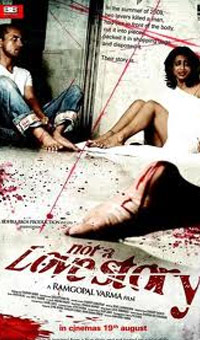
Not A Love Story (Movie Review)

Posted by pawon on Sunday, August 21, 2011

A producer makes an indecent proposal to an aspiring actor from small town, Anusha Chawla (Gill) at the beginning of this film. Even though she is more than desperate to make it big in films, keeping her self-respect intact, she walks out on the producer.

Wish Gill could use the same gumption to resist the sexual abuse that the camera constantly indulged in, through this film. Like a seasoned pervert, it sneaked into her skirt, rested right under her breasts and did a lot more unmentionable things.

At one point it got so outrageous, that I actually heard a gasp from a lady sitting behind me. Anusha wants to be a star and dresses up in tacky clothes. Justifiable. But what is not justifiable is the same tacky way in which the camera moves.

The story, obviously heavily inspired from the Maria Susairaj-Neeraj Grover case, had to be compelling. The gruesome murder of Ashish Bhatnagar (Ajay Gehi) and the body being chopped into many pieces easily makes for a gripping drama.

The scenes before and after the crime keeps you occupied, thanks largely to Deepak Dobriayal who does a fantastic job of playing Robin, the near obsessive lover of Anusha.

But by the time you reach the court scenes, the wavering hand held camera goes haywire and one feels giddy at points. I have been told that the camera was handled by some students of NFDC, a good attempt at novelty but unfortunately in most parts the film looks more like a student's project than a feature film. Gehi is good, Gill is just about average.

Zakir Husain as the crime branch investigator is good.
There is something that stands out in this film. The simmering unbridled passion between Robin and Anusha is handled very well. Even when what could have been an offensive love-making scene soon after the murder, seems justified in a strangely wonky manner, given the passion the two share.

While many might barf at the surprise climax of the film, I liked it, as it seemed like the extension of the mad passion that Robin feels for Anusha.

The film has some nice moments, only if it was not spoilt by the jarring background score (and to think Sandeep Chouta and Verma together had created magic in some of his earlier films) and oh yes, those designed to drive-you-up-the-wall camera movements.

Credit: Mid-Day.com
More about → Not A Love Story (Movie Review)

Phhir (Movie Review)

Posted by pawon on Wednesday, August 17, 2011

The best performance in this pretty but listless supernatural thriller comes from the film’s producer Vikram Bhatt who plays a sinister extortionist’s voice on the telephone.

We never see the character. But it remains the single-most expressive performance in a film suffused with deadpan performers who seem to have traveled all the way to the idyllic British countryside for a vacation.

But then they decided to make a quick thriller to supplement their holiday expenses.

The film exudes a kind of stock-slickness…The rugged castles and the verdant outdoors are well shot. The plot ? Ah….now that is another story…Rajneesh Duggal (know him?) has two lives to portray.He does the needful with the expertise of a trapeze artiste with a sprained ankle.The trip, as they say, is pre-destined.

Adah Sharma’s hair and caps suggest she’s auditioning for a bar waitresses role in a London-based sequel to Madhur Bhandarkar’s Chandni Bar. She’s supposed to read minds and predict the future. Wonder what she would have to say about this film!

The film is about a husband’s search for his missing wife (played by one Roshni Chopra who provides an all-new definition to a listness debut).

One evening the Duggal chap is supposed to join his wife for dinner at a restaurant. She just doesn’t turn up! If she didn’t like the food at the restaurant why didn’t she just say so?

For the rest of the film Duggal wears the expression of a man who can smell a bad odour. Sharma keeps getting flashes of what’s to come.

The only engaging moments in the narration occur when the film’s editor rewinds the plot to get a supplementary view on the goings-on.

That apart protagonist’s search for his spouse makes none of the impact of, say, Mani Ratnam’s Roja where Madhoo’s husband was abducted by militants during their honeymoon in Kashmir.

Phhir has neither the political or cultural specification to make the man’s search for his wife poignant or even interesting.A Pakistani cop is of no help.

To the aggrieved husband, or to the film.Pravin Bhatt’s lucid cinematography and Manish More’s savvy editing salvage what looks like a case of a missing spouse who could remain where she is for all we care.
More about → Phhir (Movie Review)